
Streamwood Previous Resident Sources
A search for previous residents begins with the era. Modern Streamwood parcels use a Property Index Number, or PIN. Older files may use a legal description, subdivision, lot and block, Hanover Township, or Hoosier Grove. Since Streamwood incorporated in 1957, the current place name may fail for earlier records.
| Source | Period | Where held | What it shows |
|---|---|---|---|
| Assessor and tax portal | Current; five-year billing history shown | Cook County portals | PIN, location, values, exemptions, mailing block |
| Recorded instruments | Online 1985-present | Cook County Clerk | Parties, type, date, number, PIN, legal description |
| Tract and record books | Before 1985; series varies | Clerk downtown facility | Earlier names, tracts, and land descriptions |
| Poplar Creek local history | Before 1957 and 1957-present | Public library | Photos, documents, oral histories, yearbooks |
| Federal census | 72-year release; 1950 open | NARA and library databases | Household names, ages, relations, address context |
| Village permits | Online start not published | Community Development and FOIA | Building, inspection, occupancy, zoning events |
Ownership and occupancy are distinct. A deed names parties to an instrument. A tax mailing block may name an agent or lender. A yearbook proves a school tie, while a census records one date. Previous residents are most credible when two sources agree on person, address, and period.
Streamwood Recording Search Fields
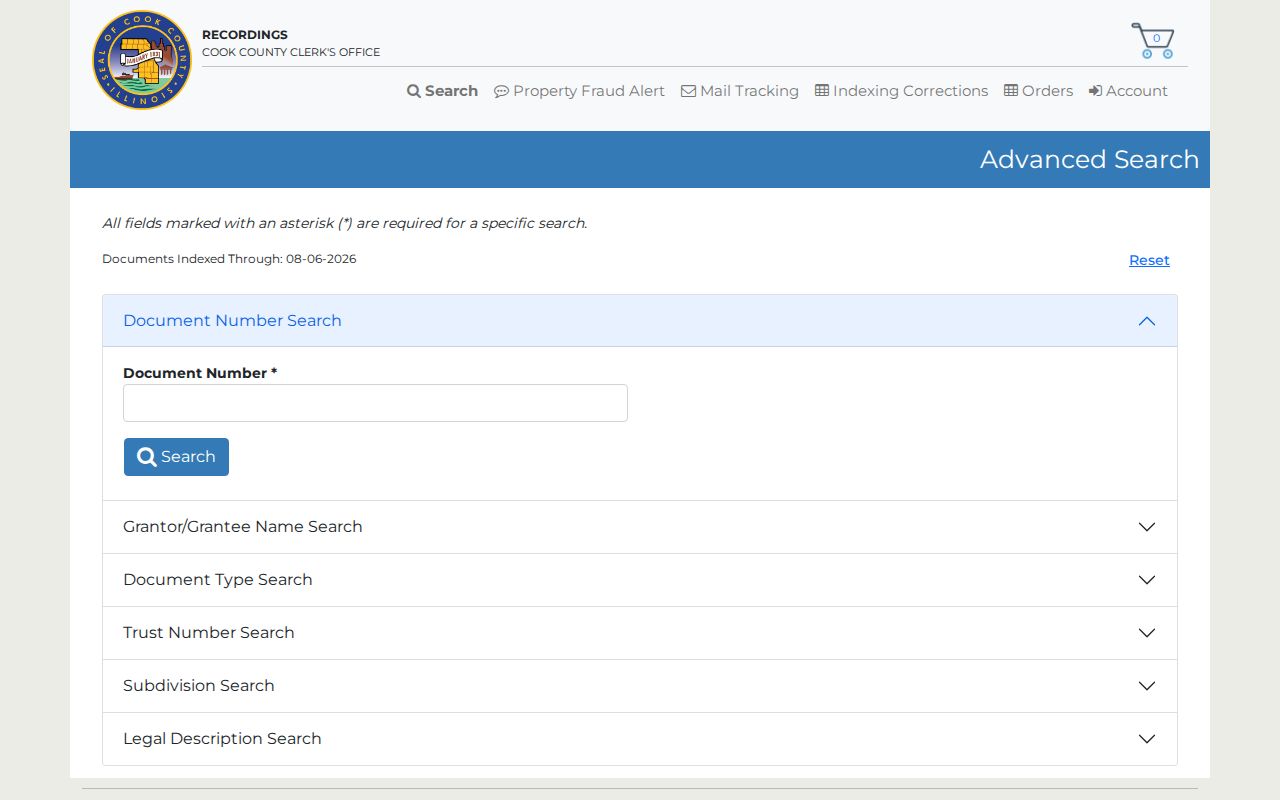
The advanced recording form is helpful when a PIN search stalls. It includes document number, grantor and grantee names, document-type choices, date limits, trust fields, subdivision, and legal-description controls. Search narrowly at first. A deed is a conveyance, while mortgages, releases, liens, assignments, and plats record other events. Keep the document type beside every result.
Open the Cook County advanced recording search before comparing its live controls with the captured official screen.
Streamwood's 1985 Record Boundary
Official Cook County reporting places online recording retrieval at 1985 to the present. Earlier work changes from a web name or PIN search to tract books and record books. Bring the last verified online deed, prior owner, subdivision, lot, block, and legal description to the downtown records route. Confirm access and current procedures with the Recording Help Desk before making a trip.
A blank online result before the cutoff does not mean no deed exists. The parcel may also have used an earlier PIN. IRAD's Cook County holdings provide an archival route for older local-government series. Mark every backward link as verified, possible, or missing rather than forcing an unproven connection.
Note: Pre-1985 research requires the land description and book route, not a guess based on a similar owner name.
Streamwood Before the Village Name
Dairy farms covered the area from the 1830s into the 1950s. In 1956, builders placed pre-assembled homes near Bartlett and Schaumburg Roads, and Streamwood incorporated in 1957. A family tied to the same ground before incorporation may appear under Hanover Township or Hoosier Grove. Later boundary disputes with Bartlett and Schaumburg can also shift the municipality named in maps, deeds, and newspapers.
The Poplar Creek collection browser has separate “Streamwood Before 1957” and “Streamwood 1957-Present Day” groups. Search both. Photos, oral histories, scrapbooks, municipal history, and yearbooks may name past residents whom a land record does not. A caption or memory is a lead, so compare it with a deed, census, or dated public file.
Separate Streamwood Mailing Names
The Cook County Property Tax Portal separates property address from mailing address. Results may include a five-year tax history, exemptions, values, recent documents, and tax-sale status. The mailing recipient can be an owner, relative, lender, tax agent, or former owner at another location. That block does not prove who lived there.
A homeowner exemption can support owner-occupancy for a tax year, but it cannot identify the full household. Likewise, a recording date is not a move date. Keep tax year, document date, directory year, census date, and source status in separate columns. This prevents a neat but false previous residents timeline.
Streamwood Permit Files Bridge Gaps
Building permits, inspection reports, occupancy certificates, zoning applications, plats, and code files can date work at an address. Current applications may run through municipal self service. Older address files generally require a focused Streamwood FOIA request. Give the exact address, possible old form, department, record type, and date range.
No official Streamwood-wide renumbering list or specific local Sanborn fire-insurance sheet was verified. Do not substitute a Chicago map or invent a renumbering year. When labels disagree, compare the recorded plat, tax map, legal description, USPS result, and Village response. A mismatch may reveal a unit, boundary, old road name, or subdivision change.
Trace Cook County Owners Backward
Resolve the current address through CookViewer and the Cook County Assessor. Save the PIN and legal description. Then use the Clerk Recordings System. The grantee receives an interest, while the grantor transfers it. Verify each name against the parcel because initials, trusts, and common names can mislead.
- Capture the current PIN, municipality, subdivision, and legal description.
- Find the newest deed and note its parties, date, number, and land description.
- Search that grantor as an earlier grantee, then confirm the same land.
- Repeat while logging parcel splits, trusts, spelling variants, and gaps.
- At 1985, ask the Recording Help Desk about tract or record books.
- Grantor and grantee
- The party transferring an interest and the party receiving it.
- Chain of title
- The linked sequence of land transfers through time.
- Legal description
- Lot, block, subdivision, tract, or boundary terms that identify land more precisely than a street label.
Match Streamwood Households to Owners
Poplar Creek Public Library is the strongest local support point when the property trail reaches people rather than title. Its physical local-history materials and digital collections cover photographs, newspapers, oral histories, municipal documents, and school sources. The library also offers in-library genealogy databases. Ask staff about an exact address, subdivision, family name, and year range rather than requesting every mention of a surname.
A reverse, or criss-cross, directory arranges entries by address and can name an occupant for its publication year. The Streamwood city directory collections cover the local shelf. Poplar Creek's verified Streamwood High yearbook items include 1979, 1987, 1990, 1992, 2001, and 2004. Yearbooks show school ties, not home addresses, but names and captions can separate people with similar names.
Use a fixed flow: address and year, directory or newspaper entry, nearest open census schedule, then deed and tax sources. Census records follow a 72-year release rule, so 1950 is open while 1960 remains closed until 2032. Obituaries and probate can explain a departure or transfer after death. Recent vital certificates are restricted, while older genealogy copies follow Cook County age rules.
The Chicago History Museum house-history guide supplies a regional method: bring the address, check directory and phone-book runs, consult criss-cross sources, test old street names and numbers, then add census and death indexes. Its holdings must be checked for Streamwood scope. No complete printed Streamwood city-directory run or standalone obituary index was verified, so gaps should be stated rather than filled from inference.
Keep a worksheet with one row for each source event. Useful columns are the name as printed, address as printed, normalized address, PIN, legal description, source date, event date, record type, custodian, and confidence. Preserve initials, married names, trust names, and spelling errors before adding a normalized form. A person can appear under several versions of a name, while two people can share one version. The parcel and date are the safeguards against merging them.
When the trail ends, ask the custodian a narrow question. Poplar Creek staff may know whether a volume, newspaper run, or donated photo collection covers the year. The Clerk can explain its older land books. Village Community Development can identify permit and plat files. A focused request gets a better answer than asking for every person ever linked to a Streamwood house, and it leaves a clear record of what was checked.
Lawful use. Research previous residents for house history, genealogy, or personal curiosity. Never use an address trail to watch, harass, threaten, or harm a living person.